Why Combine Titanium Mesh with Porous Titanium in a Composite PTL?
The design principle is straightforward: place the right pore structure in the right position. Fine porous titanium improves the interface with the catalyst layer, while a more open titanium mesh supports water and oxygen transport near the bipolar-plate flow field.
The porous transport layer, or PTL, performs several critical functions inside a PEM water electrolyzer. Located between the catalyst-coated membrane (CCM) and the bipolar plate, the anode PTL must conduct electrons, deliver water to the catalyst layer, remove the generated oxygen, and support the membrane electrode assembly under compression.
These functions are closely connected, but they do not always require the same pore structure. Fine pores can improve contact with the catalyst layer, while larger pores generally provide more open pathways for water and oxygen transport. Designing an effective PTL therefore requires more than simply maximizing porosity.
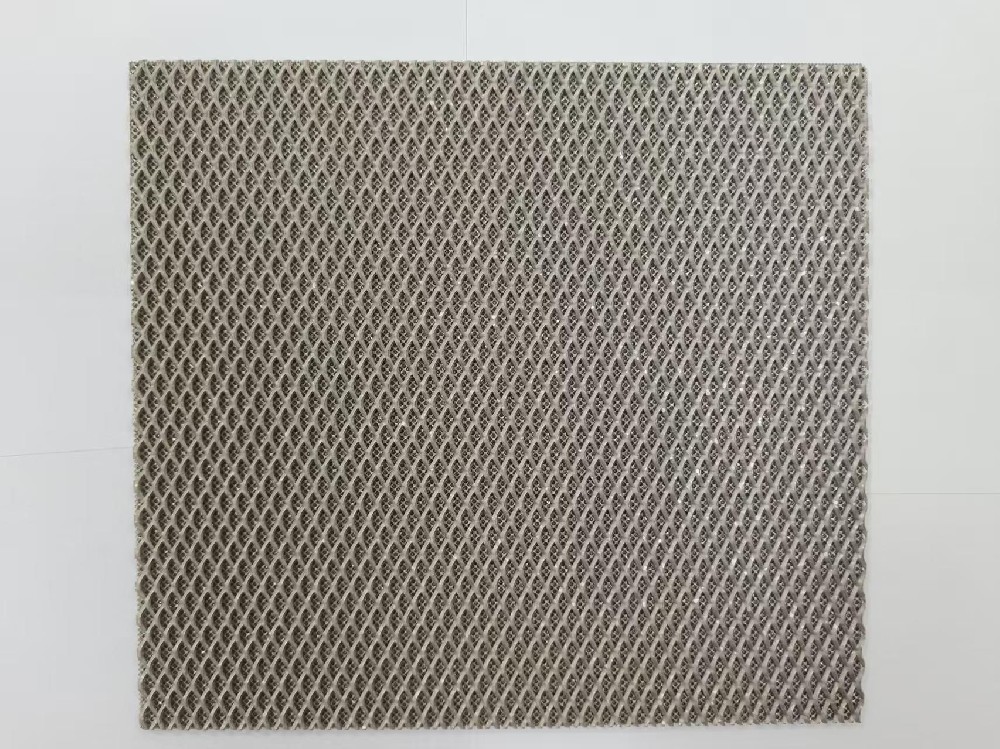
YIANTENG composite PTL sample
The structural trade-off in a single-layer PTL
A PTL with small, uniformly distributed pores creates more contact points with the catalyst layer, improving electrical and mechanical coupling at the interface. This can:
Reduce interfacial contact resistance
Improve current distribution
Increase catalyst utilization
Distribute compression more evenly
Reduce local mechanical stress on the membrane
However, making the structure too dense may restrict two-phase transport. At high current density, the PTL must continuously supply water while removing increasing amounts of oxygen. If the transport pathways are too narrow or tortuous, oxygen can accumulate within the PTL, obstruct water delivery to parts of the catalyst layer, and increase mass-transport losses.
A highly open PTL presents the opposite trade-off. Larger pores facilitate water and oxygen movement, but the reduced solid contact area may increase interfacial resistance or create a less uniform mechanical interface with the catalyst layer.
The engineering challenge is therefore not choosing between small and large pores. It is determining where each pore structure should be positioned.
How a composite PTL separates different functions
A composite PTL combines a fine porous titanium layer with a more open titanium mesh. In a typical arrangement, fine porous titanium is positioned close to the catalyst-coated membrane, while titanium mesh is placed between the porous titanium and the bipolar-plate flow field. This creates a graded transport structure rather than relying on one material to perform every function.
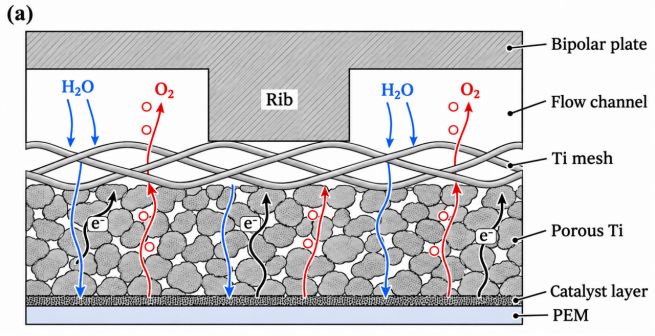
Figure 1. Conceptual composite PTL cross-section showing layer positions and transport pathways
Fine porous titanium near the catalyst layer
The layer facing the CCM requires careful control of surface condition, pore size and mechanical properties. Compared with coarse meshes or randomly oriented titanium fibers, fine porous titanium provides a relatively smooth and uniform contact surface, giving:
More contact points with the catalyst layer
More uniform electron transfer
Lower interfacial contact resistance
More consistent pressure distribution
Reduced risk of local membrane or catalyst-layer damage
Its interconnected pores still allow water to reach the oxygen-evolution interface and oxygen to move away from the reaction sites. The objective is not to eliminate porosity, but to balance permeability with interface quality.
Titanium mesh near the bipolar plate
The side facing the bipolar plate has different requirements. An open titanium mesh provides larger pathways for water and oxygen, connects the porous titanium layer with the flow field, and spreads mechanical loads across a wider area. It supports:
Lateral water distribution
Oxygen transport toward the flow channels
Mechanical support beneath bipolar-plate ribs
More uniform compression of the porous titanium layer
Mesh geometry, including wire diameter, opening size, thickness and orientation, must be selected for the operating conditions and flow-field design.
Why transport beneath the bipolar-plate ribs matters
The bipolar plate contains alternating ribs and flow channels. Water can enter the PTL directly beneath the channels, but beneath a solid rib, transport depends on lateral pathways through the PTL.
The rib also compresses the PTL. Excessive or highly localized compression reduces pore volume and changes local permeability, and uneven compression can put non-uniform stress on the CCM. Without an intermediate support structure, several issues may occur beneath the rib:
Local PTL densification
Longer lateral water-transport paths
More difficult oxygen removal
Non-uniform compression of the catalyst layer
Differences in local electrical contact
Placing a suitable titanium mesh between the bipolar plate and porous titanium helps distribute the rib load and maintain more open transport pathways.
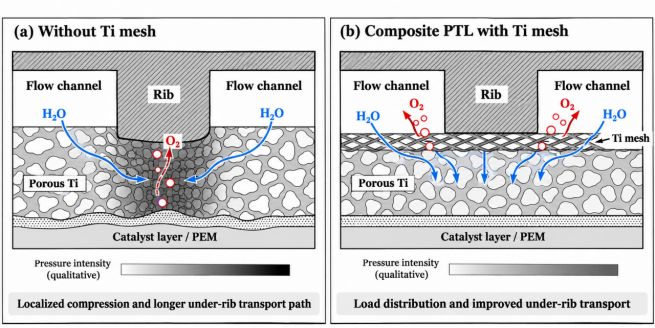
Figure 2. Qualitative comparison of transport and compression beneath a bipolar-plate rib
The objective is not to prevent compression completely. Controlled compression is necessary for electrical contact and mechanical stability. The goal is to avoid excessive local deformation while maintaining effective water, gas and electron pathways.
Potential advantages of a composite PTL
| Improved interface contact | Fine porous titanium creates a more continuous contact surface against the catalyst layer, reducing electrical discontinuities and local inactive regions. |
| More effective two-phase transport | The open mesh adds pathways for water supply and oxygen removal, particularly between the porous titanium and the flow channels. |
| Better pressure distribution | The mesh spreads part of the rib load across the porous titanium surface, reducing concentrated compression points. |
| Greater design flexibility | The two layers are engineered independently: pore size, porosity, thickness, mesh opening and wire diameter can be matched to active area, current density, flow-field geometry and compression. |
| High current density operation | As current density rises, so do water consumption and oxygen generation. A graded structure helps balance interface contact and mass transport under demanding conditions. |
These advantages depend on correct material selection and structural matching. Adding a mesh does not automatically improve every electrolyzer design.
Key parameters in composite PTL design
A composite PTL should be evaluated as part of the complete cell structure rather than as an isolated component. Important design considerations include:
| Pore size and pore-size distribution | Through-plane and in-plane conductivity |
| Porosity and permeability | Interfacial contact resistance |
| Thickness of each layer | Compression behavior |
| Surface roughness near the CCM | Bipolar-plate rib and channel dimensions |
| Titanium-mesh opening and wire diameter | Water-flow conditions and operating current density |
| Corrosion resistance and surface-coating requirements |
The mesh should be open enough to support transport, but fine enough to distribute the load without creating new local stress concentrations. Likewise, the porous titanium layer must provide enough contact area without becoming so dense that it restricts water and oxygen movement.
Composite PTL development at YIANTENG
YIANTENG develops porous titanium and titanium-based components for PEM water electrolysis. Our engineering approach considers the relationship between porous structure, surface roughness, mechanical strength, electrical contact, mass transport and stack compression.
Porous titanium thickness, pore structure and dimensions can be adapted to different development and stack requirements, and titanium mesh specifications can be selected to suit the flow field and the intended transport function. Where required, surface treatments and conductive coatings can be applied to improve interface conductivity and long-term stability under PEM anode operating conditions.
Conclusion
The best PTL is not necessarily the one with the highest porosity or the smallest pores. A high-performance PTL must establish reliable contact with the catalyst layer, provide effective pathways for water, oxygen and electrons, and remain mechanically stable under stack compression.
Combining fine porous titanium near the CCM with open titanium mesh near the bipolar plate allows these functions to be handled by different structural layers.
Put the right pore structure in the right position.