Saltwater Pool Chlorinators
Anodes for Saltwater Pool Chlorinators
Custom titanium anodes and replacement electrode cells engineered for stable chlorine output, reverse-polarity operation and dimensional compatibility with your chlorinator system.
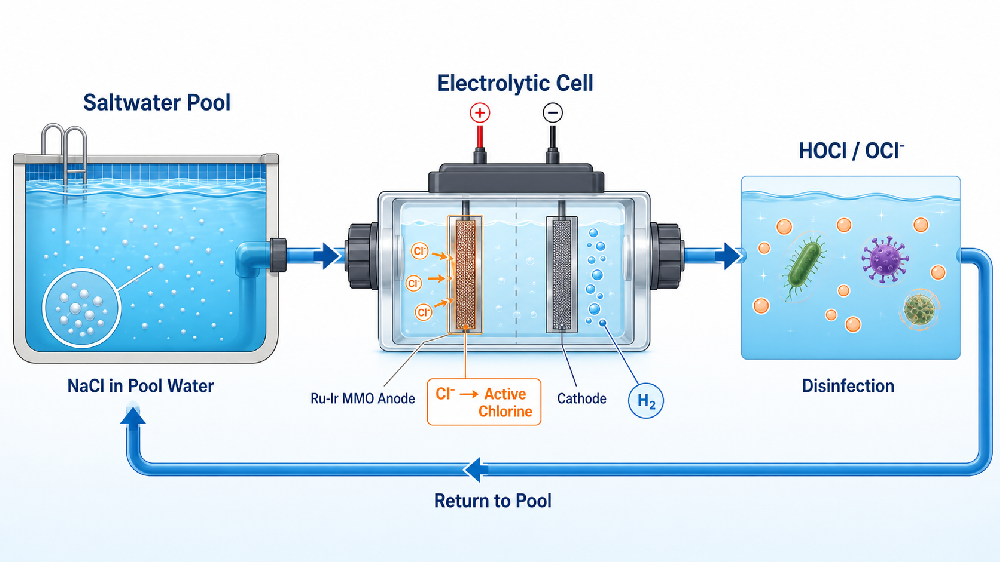
How Saltwater Pool Chlorination Works
A controlled amount of salt in the pool water supplies chloride ions. Inside the electrolytic cell, chloride is oxidized at the Ru-Ir MMO anode to form active chlorine species. The treated water then returns to the pool and provides continuous disinfection. Salt chlorination does not create a chlorine-free pool; it generates the disinfectant on site and reduces the need to handle and dose conventional chlorine products manually.
Common Electrode Problems in Pool Chlorinators
Chlorine output falls below the rated value: active area, current density, coating condition and water chemistry should be reviewed together.
White calcium scale builds up inside the cell: water hardness, local current distribution, flow conditions and polarity-reversal settings affect scaling and cleaning frequency.
Electrode life is shorter than expected: excessive current density, frequent reversal, poor water balance or an unsuitable coating specification can accelerate degradation.
A replacement cell does not fit the equipment: plate dimensions, spacing, terminals, seals, housing and electrical interfaces must match the original system.
How Yianteng Matches the Anode to Your Chlorinator
Active Area Sizing:We support coated-area selection based on chlorine output, operating current, current density and duty cycle.
Ru-Ir MMO Coating Selection:We specify chlorine-evolution coatings according to salt concentration, water temperature and operating conditions.
Polarity-Reversing Electrode Design:We configure electrode layouts and coating coverage for self-cleaning, polarity-reversing chlorinators.
Custom & Replacement Manufacturing:Dimensions, coating areas, terminals and mounting interfaces can be customized. Replacement electrodes and assemblies can be manufactured from drawings, samples or equipment data, with dimensional and electrical-interface checks before shipment.
The final recommendation is based on the complete operating condition. A fixed service-life claim with current density, daily operating hours, water chemistry and reversal settings would be technically reliable.

Send a message