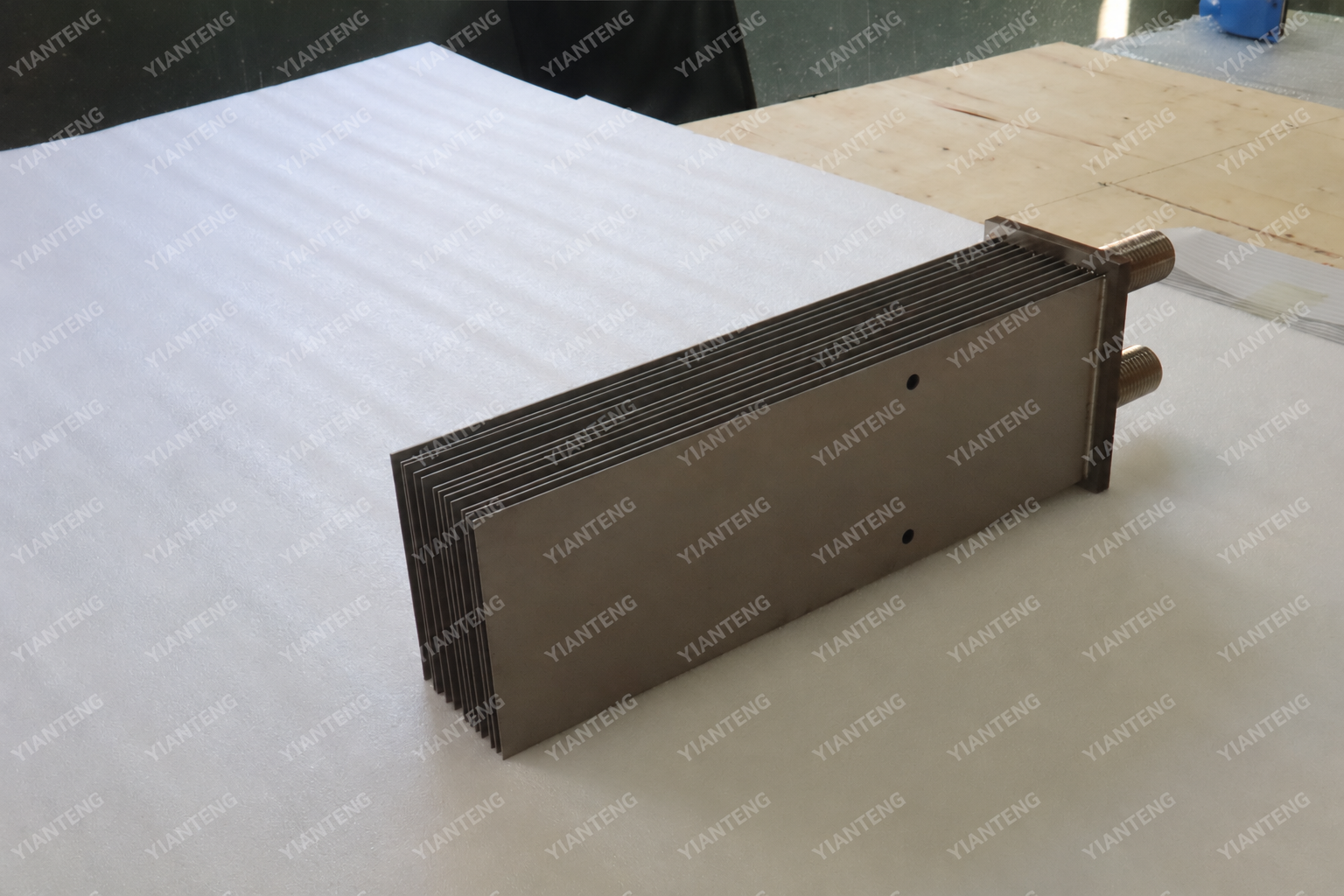
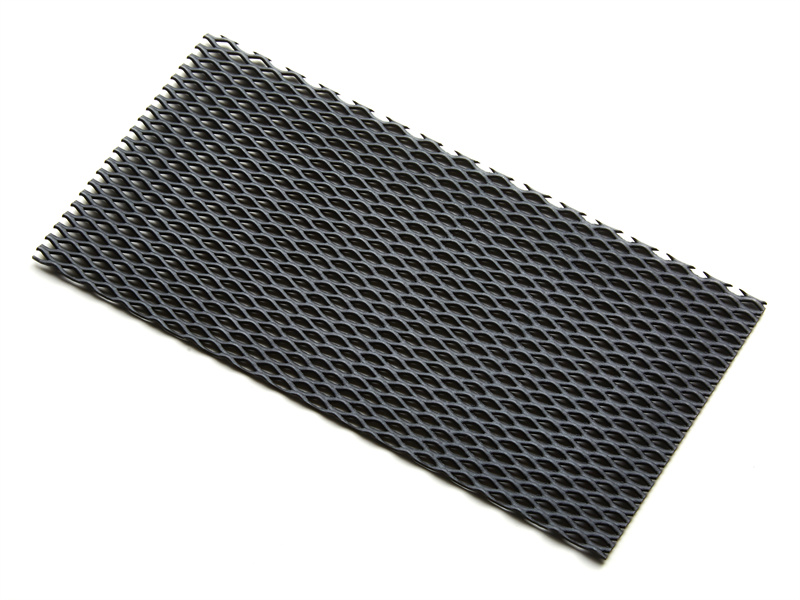
MMO titanium anodes for on-site hypochlorite generation.YIANTENG supplies Ru–Ir MMO titanium anodes in plate, mesh, rod and tube formats for prepared-brine electrochlorination cells. We match coating loading and active area to the customer’s brine concentration, target chlorine output, current density and duty cycle, and can reproduce replacement electrodes from drawings or samples. The stable titanium substrate and chlorine-evolution coating support controlled current distribution and project-specific service life. | 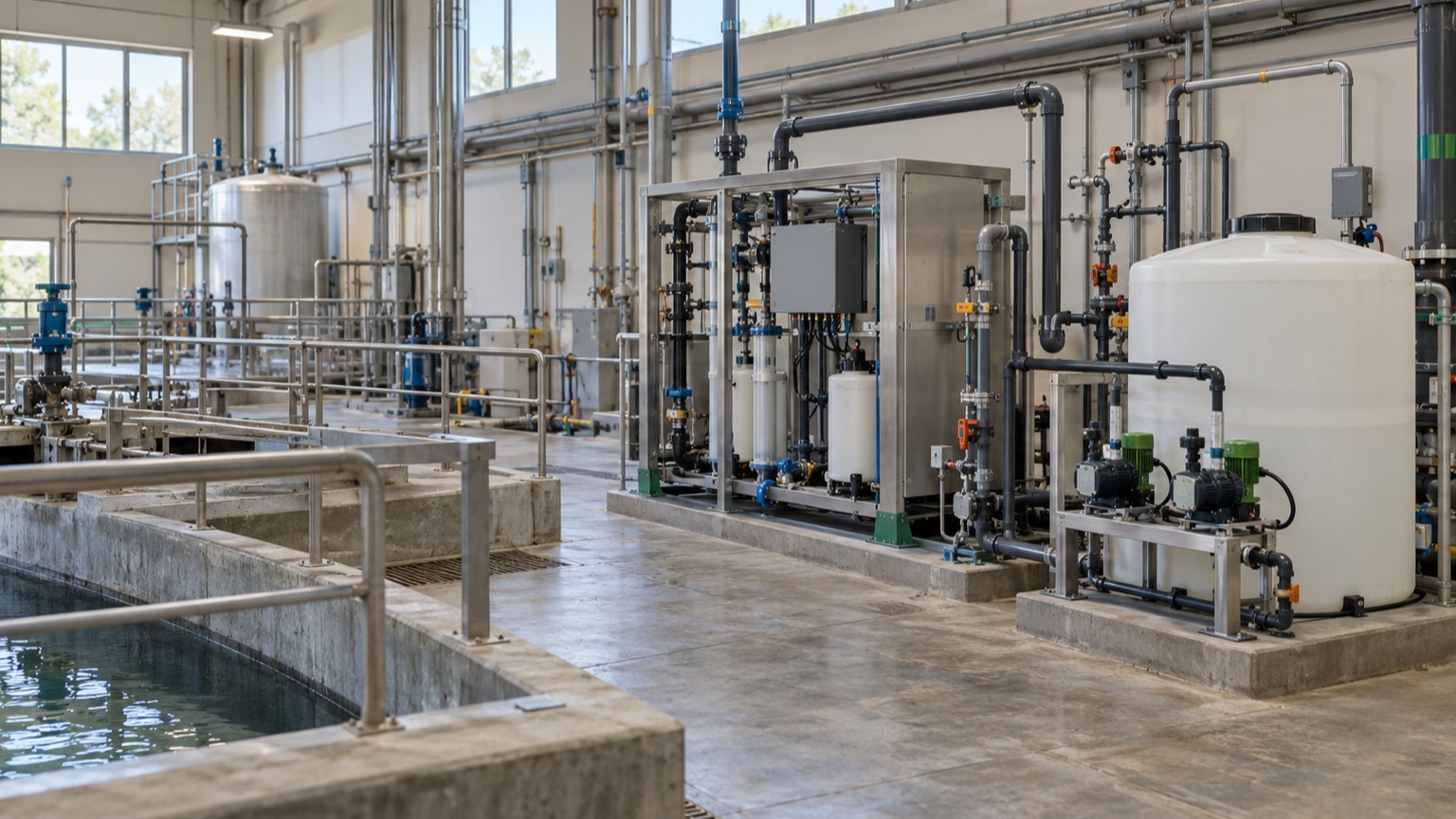 |
Grade 1 / 2 Titanium substrate | Ru–Ir MMO Chlorine-evolution coating | Plate / mesh / rod / tube Cell-matched electrode formats |
Where on-site hypochlorite generation is used
Prepared-brine electrochlorination generates dilute sodium hypochlorite at the point of use and allows production to track actual disinfection demand. Typical duties include controlled residual disinfection in municipal drinking-water plants and distribution networks, final-effluent and reuse-water disinfection in wastewater facilities, and biofouling control in industrial cooling-water and process-water circuits. Electrode selection is governed by chloride concentration, target available-chlorine output, current density, water temperature, scaling tendency and duty cycle.
How electrochlorination produces hypochlorite
Prepared brine passes through a low-voltage electrolytic cell. Chloride is oxidized at the MMO anode, while water is reduced at the cathode. Chlorine then hydrolyses in water and forms hypochlorous acid/hypochlorite; the balance depends on pH and operating conditions.
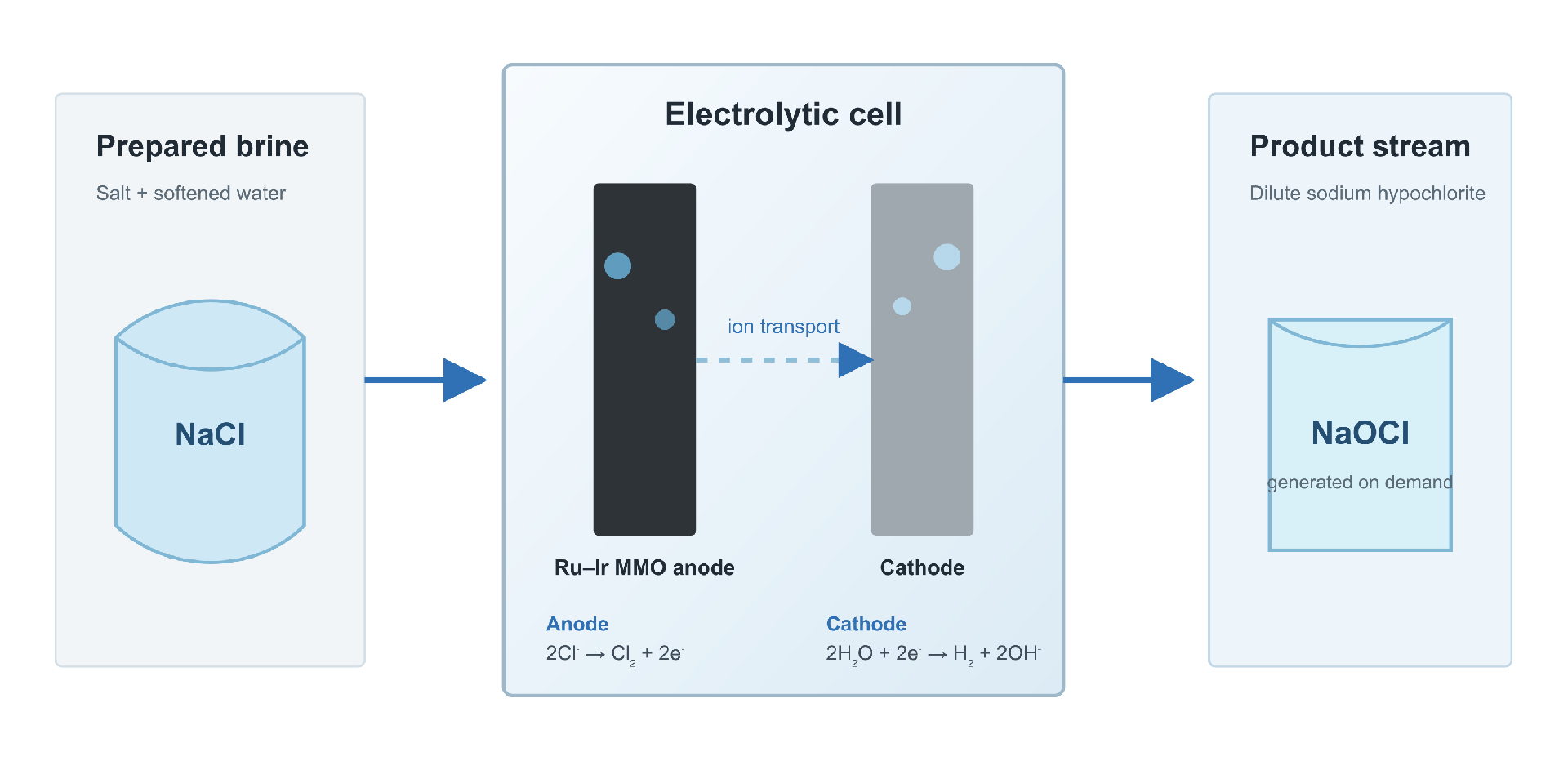 | Chloride is activatedAt the anode: 2Cl⁻ → Cl₂ + 2e⁻ Hydrogen is separatedAt the cathode: 2H₂O + 2e⁻ → H₂ + 2OH⁻ Disinfectant is formedCl₂ + H₂O ⇌ HClO + H⁺ + Cl⁻, followed by the pH-dependent HClO/OCl⁻ equilibrium. |
Why Ru–Ir MMO titanium is selected for electrochlorination
Unlike a consumable graphite body, an MMO anode separates the catalytic chlorine-evolution surface from the structural titanium substrate. This helps preserve electrode geometry, interelectrode spacing and current distribution while supporting compact, replaceable cell assemblies.
| Engineering factor | Ru–Ir MMO titanium | Graphite |
|---|---|---|
| Active surface | Catalytic Ru–Ir MMO layer designed for chlorine evolution | Carbon body participates in the anodic reaction and is consumed |
| Geometry in service | Titanium carrier and active geometry remain comparatively stable | Dimensions and electrode gap change progressively with wear |
| Cell integration | Plate, mesh, rod and tube formats support compact cell layouts | Bulkier sections and larger installation allowances may be required |
| Maintenance route | Qualified recoating or electrode-assembly replacement | Consumed graphite blocks require replacement |
Why choose YIANTENG Ru–Ir MMO anodes
YIANTENG matches Ru–Ir coating formulation, oxide loading, titanium grade and exposed active area to brine chemistry, current density, cell geometry and operating cycle. The result is an electrode specification built around chlorine-production efficiency, coating integrity, predictable durability and the maintenance strategy of the generator.
| Efficient chlorine evolutionTypical acceptance values include a chlorine-evolution potential of ≤1.13 V and chlorine-evolution polarization of ≤40 mV, supporting stable anodic response when active area and current loading are correctly matched. Uniform, well-bonded coatingControlled surface preparation and thermal coating cycles target a coating-uniformity index of ≤15%. Where specified, reinforced mass-loss acceptance is ≤8 mg; coating adhesion and integrity are verified to the agreed project inspection method. Verified accelerated durabilityAccelerated-life acceptance is ≥40 h at 20,000 A/m² under the relevant HG/T 2471-2011 test method. Project coating loading is then selected for chloride level, operating current, duty cycle and target service life. Polarity-reversal-ready designReversal-ready electrode structures and coating configurations are available for cells that periodically reverse polarity to manage scale. Reversal-life acceptance can be defined in 2.5% NaCl against the intended reversal frequency and operating cycle. |

Send a message